Contact centers are under more pressure than ever: customers want instant, personalized help, while leaders need to control costs and scale support without burning out their teams. Conversational AI for contact centers is fast becoming the go-to solution, enabling AI for customer service centers to handle routine tasks efficiently while supporting agents in real time. When implemented effectively, this technology shapes the future of contact centers—driving faster resolutions, happier customers, and a more productive, less stressed team.
High-demand contact center operations rely on computing solutions for AI-powered customer interactions to ensure smooth performance during busy periods. With these systems, conversational tools can quickly analyze customer inquiries, helping agents provide fast, accurate, and helpful responses.
Scaling AI across multiple channels requires advanced processing techniques for real-time support. By leveraging these capabilities, businesses can manage large volumes of calls, chats, and emails simultaneously without slowing down their service, ensuring every customer gets the attention they deserve.
Delivering a personalized experience depends on actionable insights. Using AI to enhance customer support insights allows contact centers to identify trends, anticipate questions, and adjust responses accordingly. This level of intelligence turns routine interactions into meaningful engagements that increase satisfaction and loyalty.
Efficiency is critical when deploying AI solutions. Cost-conscious strategies for implementing AI in support centers help organizations balance investment with results, maximizing the benefits of automation while keeping operations sustainable.
Integrating AI into workflows also benefits operational planning. Optimizing contact center processes with intelligent systems gives teams the tools to streamline routine tasks, monitor performance, and proactively address customer concerns. The result is a contact center that is responsive, efficient, and prepared for the evolving expectations of modern customers.
Top 10 Contact Center Solutions for Modern Businesses
Choosing the right technology for your contact center can dramatically improve customer experience, agent efficiency, and overall operational performance. Here’s a list of the top 10 solutions, with Bright Pattern leading the way for conversational AI integration.
1. Bright Pattern – Conversational AI for Contact Center Solutions
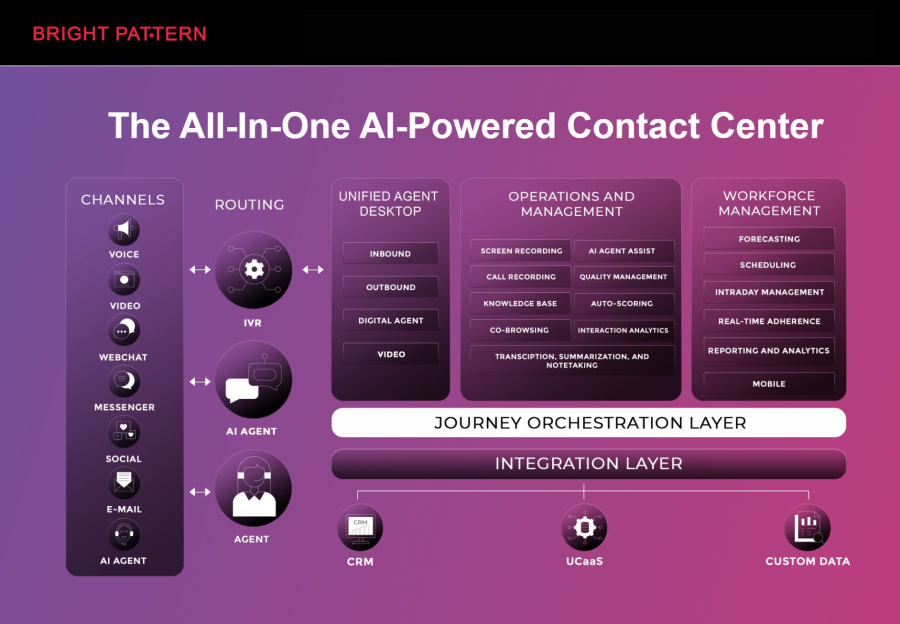
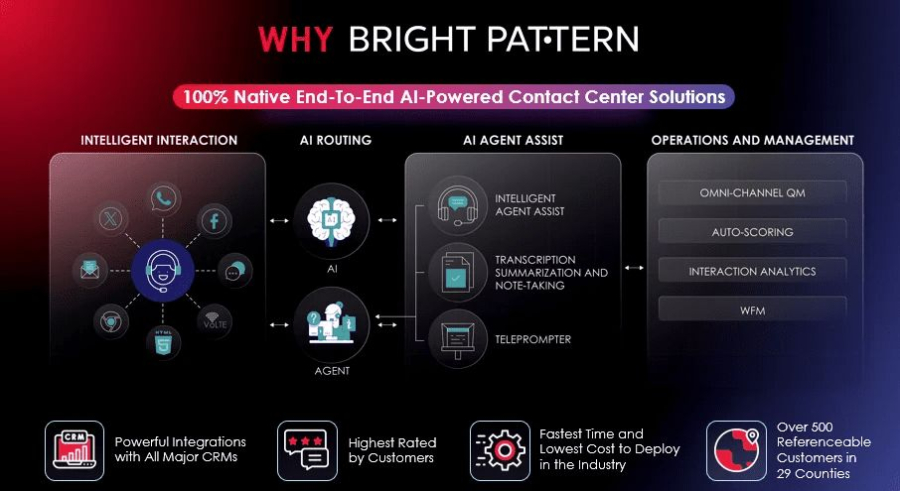
Bright Pattern is a leading platform in conversational AI for contact centers, helping businesses automate routine interactions, support agents in real time, and enhance customer satisfaction. The platform combines AI-powered tools with seamless omnichannel integration, allowing businesses to manage calls, chats, emails, and messaging apps from a single interface.
Key features of Bright Pattern:
- AI-powered virtual agents that handle common inquiries automatically
- Real-time agent assistance for faster and more accurate responses
- Omnichannel routing for consistent customer experience across channels
- Advanced analytics for monitoring performance and improving workflows
- Easy integration with CRM and other business systems for enhanced insights
Businesses using Bright Pattern report faster resolution times, higher customer satisfaction, and more productive agents, making it a top choice for enterprises seeking modern contact center solutions.
2. Five9
Five9 provides cloud-based contact center software with AI-driven automation, predictive dialing, and omnichannel support. Their platform helps businesses manage high volumes of interactions while improving response times.
3. Genesys Cloud CX
Genesys Cloud CX offers AI-assisted routing, workforce optimization, and advanced analytics. The platform is designed to deliver personalized experiences across phone, chat, and social media channels.
4. NICE inContact
NICE inContact delivers a cloud contact center platform with AI integration for self-service, agent support, and customer journey analytics. Their tools focus on increasing efficiency and reducing operational costs.
5. RingCentral Contact Center
RingCentral provides a scalable contact center solution with AI capabilities, including automated chat, voice analytics, and omnichannel routing to improve response quality and speed.
6. Talkdesk
Talkdesk offers AI-powered solutions for customer engagement, including automated workflows, real-time insights, and smart routing features that help agents prioritize and resolve interactions efficiently.
7. Avaya OneCloud CCaaS
Avaya OneCloud CCaaS combines AI and cloud technology to optimize agent performance, enhance self-service options, and provide analytics for smarter business decisions.
8. Cisco Contact Center
Cisco Contact Center solutions provide intelligent routing, AI-assisted support, and integrated analytics, enabling organizations to deliver seamless omnichannel experiences.
9. 8x8 Contact Center
8x8 delivers a cloud contact center platform with conversational AI tools, omnichannel support, and workforce management capabilities that improve productivity and customer satisfaction.
10. Mitel MiContact Center
Mitel MiContact Center offers AI integration, automated workflows, and analytics for managing interactions across multiple channels efficiently.
What Is Conversational AI in a Contact Center?
Conversational AI for contact centersrefers to AI-powered systems that can understand, process, and respond to customer messages or voice queries in natural language. Instead of rigid scripts and keyword matching, the AI recognizes intent and context, then delivers relevant answers or actions.
These systems typically show up in three main ways:
- Virtual agents / chatbotsthat handle customer conversations over chat, messaging, or in-app channels.
- Voice botsthat answer and route calls, or resolve issues directly within an IVR-style experience.
- Agent assist toolsthat listen to or read live interactions and suggest answers, next best actions, or knowledge articles in real time.
Behind the scenes, conversational AI usually includes several core technologies working together:
- Natural language understanding (NLU)to interpret what the customer means, not just what they type or say.
- Dialogue managementto keep track of context across turns in a conversation.
- Integration with your systemslike CRM, ticketing, order management, or knowledge bases so the AI can actually take action.
- Analytics and learningto continually improve intents, responses, and flows based on real interactions.
Why Conversational AI Is a Game-Changer for Contact Centers
For many organizations, the first motivation to explore conversational AI is cost savings. But in practice, the benefits go far beyond that. When implemented thoughtfully, conversational AI improves the experience for customers, agents, and leaders at the same time.
1. Better Customer Experience Around the Clock
Modern customers expect support to work like their favorite consumer apps: fast, convenient, and available 24 / 7. Conversational AI helps you deliver that without needing a huge overnight team.
- Instant responsesfor common questions such as order status, password resets, appointment changes, and simple troubleshooting.
- 24 / 7 availabilityso customers can get answers when it suits them, not just during office hours.
- Consistent qualitybecause answers come from a curated knowledge base, not from memory under pressure.
- Omnichannel conveniencewhere customers get the same level of support across web chat, mobile apps, messaging platforms, or voice.
Instead of waiting on hold or repeating information, customers experience smooth, guided conversations that resolve issues quickly or hand them off to the right human agent when needed.
2. Empowered, Less Stressed Agents
One of the most overlooked benefits of conversational AI is its impact on agent experience. When AI takes over repetitive, low-complexity work, agents get to focus on higher value, more interesting interactions.
- Reduced “busy work”because AI handles password resets, simple account updates, FAQs, and basic troubleshooting.
- Agent assistthat suggests responses, next steps, or knowledge articles in real time, so agents are never staring at a blank screen.
- Automatic call summariesthat capture key points and actions, reducing after-call work and letting agents move on faster.
- Faster onboardingbecause new agents can lean on AI prompts and guided workflows instead of memorizing every scenario.
The overall effect is a team that feels supported, not replaced. Agents can spend more time on empathy, problem solving, and relationship building while the AI does the heavy lifting in the background.
3. Stronger Operational Performance and Lower Costs
Conversational AI can have a direct impact on core contact center metrics. While exact results vary by use case and implementation, organizations typically see improvements in key areas such as:
- Containment and self-service, as a portion of contacts are fully resolved by AI without needing a human agent.
- Average handle time (AHT), when AI pre-collects information, guides troubleshooting, or drafts responses.
- First contact resolution (FCR), with AI suggesting correct answers and workflows the first time.
- Queue times and abandonment, since AI handles more volume instantly, or triages and routes issues more intelligently.
- Cost per contact, by absorbing spikes in demand and offloading routine tasks.
Because AI scales more easily than staffing, you can absorb seasonal peaks or unexpected surges in volume without massive hiring swings. That means smoother operations and more predictable budgets.
4. Actionable Insights from Every Conversation
Most contact centers are rich in data but poor in insight. Agents talk to customers all day, yet it is hard to systematically capture trends, issues, and opportunities. Conversational AI solutions often include built-in analytics that unlock this value.
- Intent analyticsthat show what customers are actually contacting you about, across channels.
- Sentiment analysisto monitor customer mood and identify friction points or at-risk segments.
- Conversation transcripts and summariesthat can be searched and analyzed for quality, training, and product feedback.
- Performance dashboardsto track containment, response quality, and customer outcomes over time.
These insights help you refine your AI flows, improve training, and even influence product, marketing, or policy decisions based on real customer voice data.
Key Use Cases of Conversational AI in Contact Centers
Every contact center is different, but certain use cases consistently deliver strong value and fast wins. Here are some of the most common and impactful scenarios.
1. Intelligent Self-Service for Common Requests
Conversational AI excels at handling straightforward, repeatable tasks. Typical examples include:
- Order and delivery status checks.
- Appointment scheduling, confirmations, and changes.
- Billing questions, balance checks, and payment arrangements.
- Account updates such as address, contact details, or preferences.
- Password resets and basic access issues.
Because these tasks often represent a large share of total volume, automating even a portion can noticeably lower queue times and agent workload.
2. Guided Troubleshooting and Triage
For more complex issues, conversational AI can guide customers through structured diagnostics or triage steps before they reach an agent.
- Guided troubleshooting flowsthat ask the right questions and narrow down potential causes.
- Issue categorizationso the conversation is routed to the best-skilled agent or specialized queue.
- Pre-collection of contextsuch as device type, operating system, account type, or recent actions.
By the time a human agent joins, they already have a clear picture of the issue and do not need to repeat basic steps, improving both speed and customer satisfaction.
3. Agent Assist and Real-Time Coaching
Agent assist is one of the highest impact applications of conversational AI because it boosts performance across both new and experienced agents. Common capabilities include:
- Suggested responsesbased on the current question or objection.
- Knowledge article recommendationsthat surface the most relevant resources instantly.
- Real-time promptsto remind agents of compliance statements, disclosures, or upsell opportunities.
- Automatic note taking and summarizationto capture the key points of each interaction.
This keeps quality and speed consistent across the team, even when contact types or policies are complex.
4. Smart Routing and Prioritization
Conversational AI can also enhance how contacts are distributed, ensuring customers reach the right resource the first time. For example:
- Detecting customer intent and urgency early in the interaction.
- Routing based on skills, language, or product expertise.
- Prioritizing high value or high risk customers for faster handling.
- Offering callback options or alternative channels when queues are long.
Smarter routing improves FCR, reduces transfers, and delivers a more seamless customer experience.
5. Proactive Outreach and Notifications
Conversational AI is not limited to inbound support. It can power proactive, two-way communication that prevents issues before they become support tickets. For instance:
- Sending shipping updates or appointment reminders with the option to reschedule via chat.
- Notifying customers about service disruptions or maintenance windows and offering self-service paths.
- Following up on recent interactions to confirm resolution or collect feedback.
This turns your contact center into a more proactive, customer-centric function instead of a purely reactive cost center.
How Conversational AI Fits into an Omnichannel Strategy
Customers rarely stay on one channel. They might start with web chat, switch to voice, and follow up via email or messaging. Conversational AI can act as the connective layer that keeps context and experience consistent.
- Shared intents and knowledgeacross channels, so your AI “knows” the same things whether it is in chat, messaging, or voice.
- Context continuityso customers do not have to repeat information when switching from a bot to a human or from one channel to another.
- Unified reportingthat shows customer journeys across touchpoints instead of isolated channel metrics.
The more your conversational AI connects with existing tools like CRM, ticketing, and workforce management, the more complete your omnichannel experience becomes.
Practical Steps to Implement Conversational AI in Your Contact Center
Rolling out conversational AI does not have to be a massive, high risk project. A phased, value-focused approach works best and builds confidence quickly.
Step 1: Define Clear Objectives and Success Metrics
Start by deciding what success looks like. Common goals include:
- Reducing average handle time or cost per contact.
- Increasing self-service rates for specific inquiry types.
- Improving CSAT or NPS on targeted journeys.
- Supporting growth or seasonal spikes without matching headcount increases.
Choose specific metrics and target ranges so you can measure the impact of each phase of your AI rollout.
Step 2: Prioritize Use Cases by Volume and Simplicity
Not every interaction is a good candidate for automation on day one. Focus on cases that are:
- High volume, so improvements have a noticeable impact.
- Low to medium complexity, with predictable steps or outcomes.
- Well documented, with clear knowledge articles or existing scripts.
Examples might include order tracking, simple billing queries, or basic technical troubleshooting. Start small, then expand as you gain confidence and data.
Step 3: Map and Design the Conversation Flows
Effective conversational AI feels natural and guided, not like a complex menu system. Invest time in designing flows that:
- Use simple, friendly language that matches your brand voice.
- Offer clear options and next steps instead of open-ended confusion.
- Handle misunderstandings gracefully by confirming intent or rephrasing questions.
- Offer easy escalation to a human agent when needed.
Involve frontline agents and supervisors in this design process. They know the real questions and the best ways to phrase answers.
Step 4: Connect to Your Core Systems
Conversational AI becomes truly powerful when it can access and update information in your existing tools. Typical integrations include:
- CRMto identify customers, view history, and personalize responses.
- Ticketing or case managementto create, update, and close cases automatically.
- Order and billing systemsto check status, balances, and payment details.
- Knowledge basesto present the most accurate and current information.
Even a small set of initial integrations can dramatically increase the usefulness and containment rate of your AI.
Step 5: Pilot, Measure, and Iterate
Launch your conversational AI with a limited scope, such as a specific channel, region, or contact type. During this pilot:
- Monitor key metrics like containment, CSAT, AHT, and escalation rates.
- Review transcripts to spot confusing phrasing, gaps in coverage, or missed intents.
- Collect feedback from agents and customers.
Use this feedback loop to refine intents, responses, and flows. Conversational AI improves best when treated as an ongoing program, not a one-time project.
Step 6: Expand Coverage and Capabilities
Once the initial use cases perform well, expand thoughtfully:
- Add new intents and flows that build on what is working.
- Extend AI to additional channels, such as messaging or voice.
- Introduce or enhance agent assist capabilities based on common pain points.
This phased approach lets you capture value early while steadily moving toward a more comprehensive AI-powered contact center.
Best Practices for High-Performing Conversational AI
To maximize results and keep customers happy, keep these best practices in mind as you design and grow your conversational AI.
1. Always Provide a Human Escape Hatch
Even the best AI cannot handle every situation. Make sure customers can easily reach a human when they need to, especially for:
- Complex or emotionally sensitive issues.
- High value accounts or transactions.
- Cases where the AI is clearly stuck or repeating itself.
Clearly signalling that a human is available keeps trust high and reduces frustration.
2. Be Transparent That Customers Are Talking to AI
Customers generally appreciate honesty. Let them know when they are interacting with a virtual assistant, and explain what it can help with. This sets expectations and builds confidence when the AI performs well.
3. Use Your Agents as Co-Designers
Your agents are a gold mine of practical knowledge. Involve them in:
- Identifying common questions and ideal answers.
- Reviewing AI conversations to highlight improvement opportunities.
- Designing agent assist prompts that genuinely reduce effort.
When agents feel ownership over the AI, adoption rises and results improve.
4. Train and Update Regularly
Customer behavior, products, and policies change over time. Keep your AI up to date by:
- Regularly reviewing intents and adding new ones.
- Refreshing the knowledge base to reflect new offers, pricing, or procedures.
- Fine tuning responses based on real conversation data.
A simple monthly or quarterly review cycle can keep performance strong and prevent outdated information from slipping through.
5. Balance Automation with Personalization
Automation does not have to feel robotic. Use available data to personalize experiences thoughtfully, for example:
- Greeting customers by name when authenticated.
- Referencing recent interactions or purchases when relevant.
- Adapting flows based on customer profile, preferences, or history.
This kind of personalization helps customers feel known and valued, even when they are interacting with AI.
Measuring the Impact of Conversational AI
To prove and optimize the value of conversational AI in your contact center, track both operational and experience metrics. Common measures include:
Operational Metrics
- Containment rate: percentage of interactions fully handled by AI.
- Average handle time (AHT): for both AI and assisted interactions.
- First contact resolution (FCR): how often issues are resolved in a single interaction.
- Transfer and escalation rates: from AI to human agents.
- Cost per contact: before and after AI implementation.
Customer and Agent Experience Metrics
- Customer satisfaction (CSAT)with AI and human assisted contacts.
- Net Promoter Score (NPS)for key journeys.
- Agent satisfaction and engagement, often measured through internal surveys.
- Agent productivity, such as interactions handled per agent and after call work time.
By combining these views, you can see where AI is driving clear wins, where it needs refinement, and where to expand next.
The Future of Conversational AI in Contact Centers
Conversational AI is progressing quickly, especially with advances in large language models and more powerful real-time processing. For contact centers, this means:
- More natural conversationsthat feel closer to human dialogue, with better handling of nuance and context.
- Smarter agent assistancethat not only suggests answers but anticipates needs and automates more back-office actions.
- Deeper personalizationbased on richer data about customer behavior, preferences, and history.
- Stronger alignment with business goalsas AI is tuned not just for resolution, but also for loyalty, retention, and growth.
What will not change is the core purpose: using technology to make every interaction more helpful, more human, and more efficient. The most successful contact centers will be the ones that blend the strengths of AI with the empathy and creativity of human agents.
Bringing It All Together
Conversational AI for contact centers is no longer a futuristic idea. It is a practical, proven way to:
- Deliver fast, convenient, 24 / 7 support.
- Reduce operational costs without sacrificing quality.
- Empower agents with real-time guidance and automation.
- Unlock insights from every customer conversation.
By starting with clear goals, focusing on high value use cases, and treating AI as a continuous improvement program, you can transform your contact center into a powerful, customer centric engine for your business.
The opportunity is not about replacing people; it is about giving your teams the intelligent tools they need to excel. With conversational AI as a partner, every interaction becomes a chance to impress, delight, and build lasting loyalty.
